Multiple identical parts
A single high-precision master model can be used to manufacture multiple identical components.
Vacuum Casting
Low-volume polyurethane components with an appearance close to series-produced parts.
Start a project↗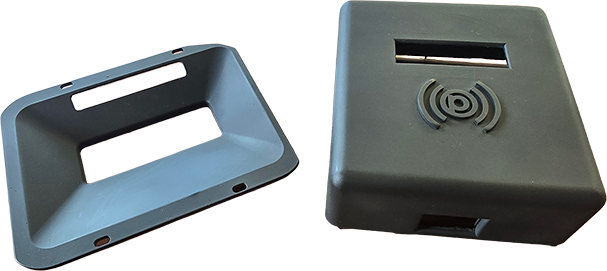
Vacuum casting makes it possible to produce multiple identical polyurethane components from a single high-precision master model within a short lead time.
It is particularly suitable for prototypes, pre-series parts, market validation, presentation models and low-volume end-use products.
With the appropriate material and finishing solutions, colour, surface appearance and visual characteristics can be tailored to the required result.
Vacuum casting becomes especially valuable when multiple identical and realistic parts are required, but investment in injection moulding tooling is not yet justified.
A single high-precision master model can be used to manufacture multiple identical components.
Details, surface textures, colours and material feel can be brought close to the final production product.
The design can still evolve without immediately committing to expensive series-production tooling.
Vacuum casting provides a practical transition between one-off prototyping and higher-volume series production.
Send us your 3D model and required quantity. We will assess whether 3D printing, vacuum casting or another technology provides the best technical and economic result.
Help me chooseA high-precision physical model is produced from the final geometry.
A mould is created from the master model, reproducing its details and surface.
Liquid polyurethane components are cast into the mould under vacuum.
After curing, the component can be finished and surface-treated as required.
After inspection, the finished parts are ready for testing or end use.
Vacuum casting is particularly useful when development requires not just one prototype, but several identical and realistic components.
We select the material system according to the component's function, mechanical loading, environmental conditions and required appearance.
Rubber-like material that can be coloured and adjusted between Shore A 25–95 hardness.
Blue silicone with Shore A 60 hardness.
Transparent silicone with Shore A 45 hardness.
Black flexible resin for spark protection in electrical devices. Shore D1 46.
ABS-like black resin with automotive-grade properties, chemical resistance and good mechanical characteristics. Shore D1 82.
PP- or HDPE-like, impact-resistant and colourable resin. Shore D1 75.
Transparent / translucent PC-like resin that can be coloured and modified with additives. Shore D1 85.
Transparent resin with food-industry certification. Shore D1 82.
ABS-like resin with good thermomechanical properties and colourability. Shore D1 84.
Opacifying additive for PRC1810 that diffuses light.
Glass powder additive for PR600, PR700 and PR777 to increase strength.
Provides limited electrical conductivity when mixed with PR600, PR700 or PR777.
Makes PR600, PR700 and PR777 more flexible.
Used to create copper- or carbon-effect appearances.
Vacuum casting is not the optimal solution for every component or production volume. Geometry, size, material requirements and surface expectations must all be considered together.
In some cases 3D printing is faster, while at higher volumes RIM moulding or injection moulding may be more appropriate.
Multiple identical parts are required, but the volume does not yet justify major production tooling investment.
Surface quality, colour, level of detail and visual character should closely resemble the final product.
The product needs to be presented to and tested by customers, partners or users.
Fine details and complex geometric features need to be reproduced.
The design may still change based on testing and feedback.
Injection mould tooling is not yet technically or economically justified.
We can discuss the master model, required quantity, material properties and surface requirements.
Request a quoteWe primarily use vacuum casting for projects where quality, flexibility and economical low-volume production are equally important.
From the master model and silicone mould to the material system and finishing process, every stage is tailored to the required result.
Together with 3D printing, RIM moulding and our other technologies, we select the process that best fits the specific product.
Show us what you want to create.
Tell us briefly about your project, expected quantities and, if available, attach your drawing or 3D model.