Cost-effective low and medium volumes
Production can begin with significantly lower tooling investment than conventional injection moulding while still producing functional end-use parts.
RIM Moulding
Low and medium-volume polyurethane part production with flexible material properties and lower tooling investment.
Start a project↗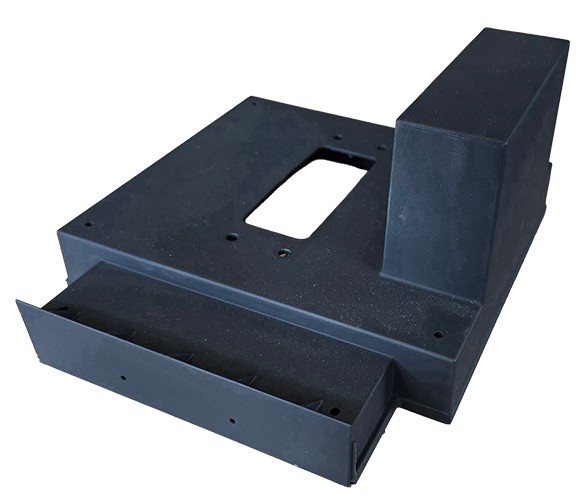
RIM moulding provides an efficient solution for producing low and medium volumes of polyurethane components when functional, end-use parts are already required.
Compared with conventional injection moulding, RIM enables series-like production with lower tooling costs and shorter production preparation times.
By selecting the appropriate polyurethane system, hardness, flexibility, impact resistance and surface appearance can all be tailored to the application.
RIM becomes particularly valuable once a product has moved beyond the prototype stage but the investment required for conventional injection moulding is not yet justified.
Production can begin with significantly lower tooling investment than conventional injection moulding while still producing functional end-use parts.
The process is well suited to larger polyurethane components with variable wall thicknesses and complex geometries.
The hardness, stiffness, flexibility and other characteristics of the polyurethane system can be adapted to the application.
Compared with conventional injection moulding, the route from prototype to functional low or medium-volume production can be significantly shorter.
Send us your 3D model, required quantity and key technical requirements. We will assess whether RIM, vacuum casting or injection moulding offers the best solution.
Help me chooseThe product geometry and manufacturing requirements are adapted to the RIM process.
The tool is designed according to material flow, release, wall thickness and required production volume.
The appropriate polyurethane system is selected according to the required mechanical and surface properties.
After mixing, the reactive components are introduced into the mould where they cure through a chemical reaction.
After post-processing and inspection, the component is ready for end use or further validation.
RIM is particularly suitable when a project has moved beyond a single prototype and requires functional low or medium-volume production.
Selecting the right polyurethane system is one of the most important decisions in RIM moulding. The required properties should already be defined during the engineering stage.
The required softness or stiffness can be tailored to the application using the appropriate polyurethane system.
Different formulations can provide flexible or more rigid mechanical characteristics.
The material system can be selected according to the expected mechanical loads.
The intended environment and operating temperature are important factors in material selection.
For moving, contacting or loaded components, durability is considered during material selection.
The required appearance and surface characteristics also influence the selection of the material system.
RIM can be an excellent choice when you need more than one or two prototypes but conventional injection moulding is not yet economically justified.
Quantity is only one factor. Geometry, component size, surface requirements and material properties all play an important role in the decision.
The technology can be particularly attractive for volumes ranging from several dozen to several thousand parts.
For larger components, RIM can often provide a more economical and flexible solution than alternative processes.
For functional end-use parts, material properties become a key consideration.
Good surface quality and consistent appearance can be achieved with the right tooling and material system.
RIM can be particularly useful when the design may still evolve but series-like production is already required.
A conventional injection moulding tool may not yet be justified or economically viable.
We can review the component design, tooling concept, polyurethane material system and planned production volume together.
Request a quoteEarly versions of a new product can be validated quickly using 3D printing, followed by pre-series or low-volume production using RIM moulding.
This allows the product to be tested using near-final materials and appearance without the significant investment required for full series production.
If production volumes later increase, the development path can naturally continue toward the appropriate series-production technology.
Show us what you want to create.
Tell us briefly about your project, expected quantities and, if available, attach your drawing or 3D model.